



When a US wholesaler or retailer orders a custom solid wood dining table from an Indian manufacturer, most of what happens between "PO confirmed" and "container arrives at port" is invisible to them. That's not a knock on buyers — it's just how the industry has worked for years. You send specs, you wait, you get photos, you approve, you wait again, and eventually a container shows up.
The problem is that this black-box approach is exactly where things go wrong. A buyer who understands the actual manufacturing process — what happens at each stage, where delays typically creep in, and what decisions get locked in early versus late — asks sharper questions, catches problems before they're expensive to fix, and sets realistic timelines with their own retail or hospitality clients.
This guide walks through custom solid wood dining table manufacturing exactly as it happens on a factory floor in Jodhpur, India, from the first design brief to the moment the table is loaded into a container. If you're sourcing dining furniture more broadly, our complete guide to sourcing solid wood dining tables wholesale from India is a useful companion to this one.
The 8 Stages at a Glance
Before the detail, here's the full sequence in one place:
- Design brief — dimensions, wood species, construction style, and finish are locked in
- Wood selection and sourcing — timber is matched to the design
- Kiln-drying and moisture stabilization — lumber is brought to a stable moisture content
- Cutting, joinery, and tabletop construction — the table is physically built
- Sanding, finishing, and color matching — surface treatment is applied and checked for consistency
- Quality inspection before packing — the finished table is checked against spec
- Packaging for export — the table is protected for a six-to-eight-week ocean voyage
- Container loading — the packed table is loaded for shipment
Why Understanding the Manufacturing Process Matters to US Buyers
A dining table looks simple from the outside: a top, four legs, maybe an apron. But solid wood dining table production involves more decision points than most buyers expect — wood moisture content, slab selection, joinery method, finish batching, and packaging design all affect the final product's durability and how it survives a six-to-eight-week ocean voyage.
Buyers who skip understanding this process tend to make the same mistakes: approving designs from a single photo, assuming "solid wood" means one uniform construction method, or not realizing that a table's extension mechanism needs to be tested before it ever leaves the factory. (We cover these specific mistakes in more depth in 7 Mistakes US Wholesalers Make When Ordering Custom Dining Tables from India.)
Knowing the process also helps you communicate better with your manufacturer. Instead of a vague "make it look like this photo," you can specify the exact stage where a change needs to happen — which almost always saves both time and money.
Stage 1: The Design Brief — What a Manufacturer Actually Needs
Everything starts here, and it's also where most delays originate. A design brief that's missing information doesn't get rejected — it gets interpreted, and interpretation is where custom orders quietly go sideways.
Core Specifications a Complete Brief Should Include
- Dimensions — length, width, height, and (if applicable) extended length with leaves in place
- Seating capacity — this affects table length and apron placement, especially for benches or mixed seating
- Wood species — mango, acacia, sheesham, or another hardwood (see our comparison of mango wood vs. sheesham wood dining tables if you haven't settled on a species yet)
- Tabletop style — single slab, edge-glued panel, live-edge, or inlay/pattern work
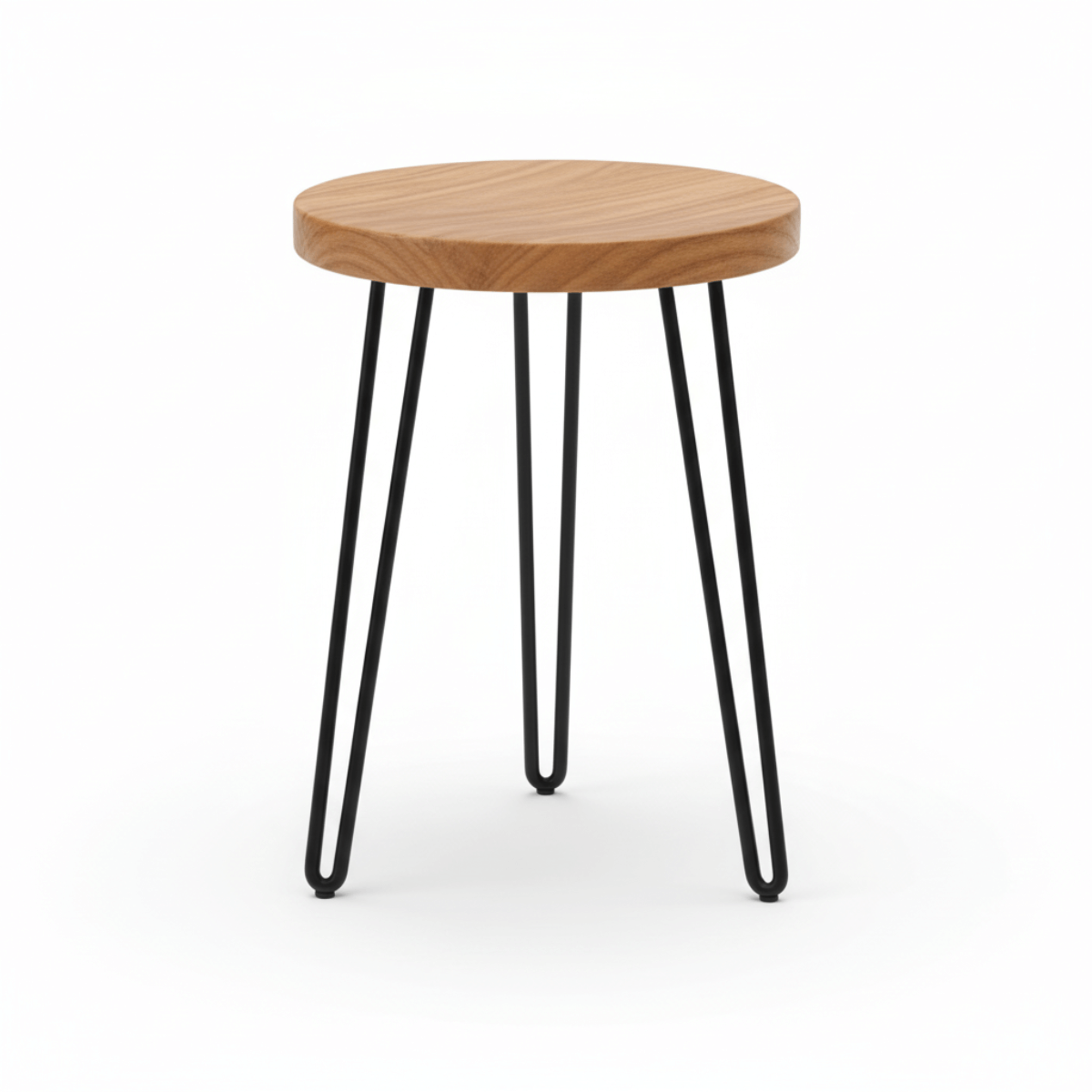
- Leg and base style — trestle, pedestal, four-leg, hairpin, or a metal-and-wood hybrid base
- Finish — natural, distressed, whitewash, two-tone, or a custom stain matched to an existing collection
- Extension mechanism — butterfly leaf, draw-leaf, or none
If you're placing an OEM or private-label order rather than a one-off custom piece, your manufacturer will also confirm minimum order quantity (MOQ) per design at this stage — worth raising early if you're considering more than one design in the same order, since MOQ is usually set per SKU rather than shared across a whole order. Our guide on private-label solid wood dining furniture covers how OEM programs are typically structured if that's the route you're considering.
CAD Files, Photos, or Sketches: What Actually Speeds Things Up
A dimensioned CAD drawing or technical sketch is the fastest path to an accurate first sample. A reference photo alone is workable, but it forces the factory's design team to make assumptions about proportions, apron depth, and leg thickness — assumptions that may not match what you had in mind. If you'd rather start from an existing design than build one from scratch, our dining table design guide is a good starting point for reference.
If you're working from a photo, the single most useful thing you can add is a scale reference (a stated overall length or a comparison to a known product) so the design team isn't guessing at proportions.
The Gaps That Cause the Most Delays
In practice, the specifications most often left out of a first-round brief are: acceptable moisture content range, finish tolerance (how much variation is acceptable between pieces), and whether the buyer wants to approve a physical sample before bulk production starts. Locking these three items into the brief upfront routinely saves a full round of back-and-forth later.
Stage 2: Wood Selection and Sourcing
Once the brief is locked, the manufacturer sources timber matched to the design. For solid wood dining tables headed to the US, mango wood and acacia are the most commonly exported species from Rajasthan, largely because both are dense hardwoods that finish well and hold up across different US climate zones.
Slab Selection and Grain Matching
For a single-slab tabletop, this stage is where craftsmanship becomes visible. The factory selects slabs wide and long enough to meet the table's dimensions with minimal waste, then evaluates grain pattern and color for consistency — especially important if the order includes multiple identical tables that need to look like a matched set on a showroom floor.
For edge-glued or panel-constructed tops, several narrower boards are matched for grain and color before being joined, which is a different process with different stability characteristics (more on this in Stage 4).
Stage 3: Kiln-Drying and Moisture Stabilization
This stage doesn't produce anything visually interesting, which is exactly why it gets overlooked — but it's arguably the most important step for a table's long-term durability in a US home or hospitality setting.
Freshly cut or air-dried lumber holds far more moisture than is stable for indoor use in a heated, climate-controlled US interior. Kiln-drying brings the wood down to a moisture content that's in equilibrium with typical indoor conditions, which is what prevents the tabletop from shrinking, cracking, or cupping after it arrives — particularly in drier climates or during winter heating season.
This stage can't be rushed for large panel tops. Wide slabs and glued panels need time to stabilize evenly through their full thickness, not just at the surface. A table that looks finished but was pulled out of the kiln too early is more likely to develop stress cracks weeks or months after delivery — a defect that's expensive and reputationally costly to deal with after the fact.
Stage 4: Cutting, Joinery, and Tabletop Construction
This is where the table physically comes together, and where the construction method has the biggest impact on both price and long-term performance.
Solid Slab vs. Edge-Glued Panel Tops
Both are legitimate solid wood construction methods, but they differ in price, appearance, and how they handle wood movement:
| Construction Method | How It's Made | Appearance | Typical Cost Impact | Stability Notes |
|---|---|---|---|---|
| Solid slab top | Cut from one continuous piece of timber | Dramatic, uninterrupted grain | Higher — limited by available slab width | Movement is concentrated across one wide piece, so even, careful kiln-drying matters more |
| Edge-glued panel top | Several narrower boards joined along their long edges | Grain varies board to board, still fully solid wood | More cost-efficient at scale | Movement is distributed across multiple boards, which often makes panel tops more dimensionally stable |
Neither method is a shortcut — a well-made panel top, glued and reinforced correctly, is standard professional construction. The point is knowing which one you're getting, since it affects both what the table looks like and what you should expect to pay.
Leg and Apron Joinery
The joinery method used to attach legs to the apron affects long-term structural durability, and it's worth specifying explicitly rather than assuming:
| Joinery Method | Relative Strength | Typical Use | What to Ask For |
|---|---|---|---|
| Mortise-and-tenon | Strongest, traditional | Mid-to-premium dining tables | Confirm this is used if the order is going into a hospitality or contract setting with heavy daily use |
| Dowel joinery | Moderate | Standard production, faster turnaround | Ask about dowel diameter and depth for tables that will see heavy use |
| Metal corner brackets | Fastest to produce | Budget-tier production | Confirm bracket gauge and how it's fastened to the frame |
Extension Mechanisms
If the design includes a butterfly leaf or draw-leaf extension, this is where the mechanism is built and fitted. Extension hardware needs to glide smoothly and lock securely — a detail that should be physically tested, not just visually checked, before the table moves to finishing.
Stage 5: Sanding, Finishing, and Color Matching
Once construction is complete, the table goes through progressive sanding before finish is applied. Common finish options include natural (clear-coated to show the wood's grain), distressed or sand-blast finishes (which create texture and a lived-in look), and solid or two-tone stains for a more contemporary aesthetic.
Batch Consistency Across a Production Run
For bulk or private-label orders, finish consistency across every unit in the order matters as much as the finish itself. Stain absorption varies slightly with wood grain, so factories that manage this well finish tables in matched batches and check color consistency against a reference sample throughout the run — not just at the start.
Stage 6: Quality Inspection Before Packing
Before any table is wrapped for shipment, it goes through a structured inspection at the factory: moisture content is checked at multiple points on the tabletop and legs, every joint is tested for tightness, the finish is compared against the approved reference sample, and final dimensions are measured against the original spec sheet. For tables with an extension mechanism, this is also where it gets physically opened and closed to confirm it operates smoothly, not just checked visually in the closed position.
This checkpoint exists because it's the last point in production where a defect is cheap to catch — once a table is packed and loaded, fixing the same issue costs significantly more in time, freight, and goodwill. We've broken this stage down in full detail, including exactly what tools and tests should be used, in Solid Wood Dining Furniture Quality Control: What to Inspect Before Shipment.
Stage 7: Packaging for Export
Dining tables are bulky, heavy, and prone to corner and edge damage if packed carelessly. Export-ready packaging typically includes corner protectors, edge guards, corrugated or foam wrap around the tabletop surface, and moisture-absorbing desiccant packs inside the carton to manage humidity during transit.
Knock-Down vs. Fully Assembled Packing
For larger tables, many manufacturers offer knock-down (KD) packing — legs and apron shipped separately from the top, with simple on-site assembly — rather than shipping the table fully built. KD packing reduces the table's shipping footprint, which lowers freight cost per unit and reduces the risk of damage from a bulkier, harder-to-secure fully assembled piece.
Stage 8: Container Loading
The final stage is loading the finished, packed tables into the container, and table shape has more influence on this than most buyers expect. A rectangular table with a knock-down base loads efficiently because it stacks flat and predictably; a large round table or one with a fixed, wide pedestal base takes up disproportionate space and is harder to secure tightly against other cargo, which can leave unused volume in the container and push up the per-unit freight cost.
This is worth raising with your manufacturer at the design stage, not after production is finished — asking whether a design is available in a knock-down format, and how many units of your specific table typically load into a standard 20ft or 40ft container, gives you a much more accurate freight estimate before you commit to an order. For the full math and loading strategy, see our guide on how many dining tables and chairs fit in a 40ft container.
Typical Production Timeline for a Custom Dining Table Order
Timelines vary with order size, wood species availability, and how much back-and-forth happens during design approval, but a general framework looks like this: design approval and sample production come first, followed by bulk production once the sample is signed off, then finishing, quality inspection, packing, and loading. The sample-approval stage is usually the biggest lever a buyer has over the total timeline — the faster feedback moves in that stage, the sooner bulk production can start.
Ordering during a manufacturer's peak season, or requesting a wood species that needs to be sourced rather than kept in regular stock, can extend the timeline further. It's worth asking your manufacturer for a stage-by-stage timeline specific to your order rather than a single end-to-end estimate.
Frequently Asked Questions
How long does it take to manufacture a custom solid wood dining table from India?
Timelines depend on order size, wood species, and how quickly the design sample is approved, since sample approval typically happens before bulk production begins. Asking your manufacturer for a stage-by-stage breakdown — sample, bulk production, finishing, QC, packing — gives a more accurate picture than a single overall estimate.
What information should I include in a design brief for a custom dining table?
At minimum: exact dimensions, wood species, tabletop construction style (slab or panel), leg and base design, finish type, extension mechanism (if any), and your acceptable moisture content and finish-tolerance range. A dimensioned sketch or CAD file speeds up the first sample significantly compared to a reference photo alone.
Can I request a specific wood species or finish for my dining table order?
Yes. Most manufacturers that handle custom and private-label orders offer a choice of wood species — commonly mango, acacia, or sheesham — along with multiple finish options such as natural, distressed, whitewash, or a custom stain matched to your existing collection.
What's the difference between a solid slab tabletop and an edge-glued panel top?
A solid slab top is cut from one continuous piece of timber, while an edge-glued panel top joins several narrower boards along their edges. Both are legitimate solid wood construction methods; a well-made panel top is structurally comparable to a slab top and often more resistant to warping, since wood movement is distributed across multiple boards rather than concentrated in one wide piece.
Do I need to approve a sample before bulk production begins?
It's strongly recommended. A physical or thoroughly documented sample lets you confirm dimensions, finish color, joinery quality, and any extension mechanism before the manufacturer commits materials and labor to the full order — catching a design mismatch at the sample stage is far less costly than catching it in a finished container.
Can I get a video tour of the factory during production?
Most established manufacturers will provide video updates on request, especially for larger or first-time orders — a walkthrough of the sample being built, or footage of your specific order at the joinery or finishing stage. It's reasonable to ask for this in your design brief or purchase order rather than assuming it will happen automatically, and it's a useful way to verify progress without needing to travel to Jodhpur in person.
Getting Your Next Custom Order Right From the Start
Understanding how a custom solid wood dining table actually gets made — from the first dimensioned sketch through kiln-drying, joinery, finishing, and container loading — puts you in a much stronger position as a buyer. You'll write tighter design briefs, ask better questions at each stage, and know exactly where to focus your attention when something needs to change mid-production.
If you're planning a custom or private-label dining table order, browse our solid wood dining tables collection for design inspiration, or contact our team with your specifications for a design brief template and production timeline specific to your order.